
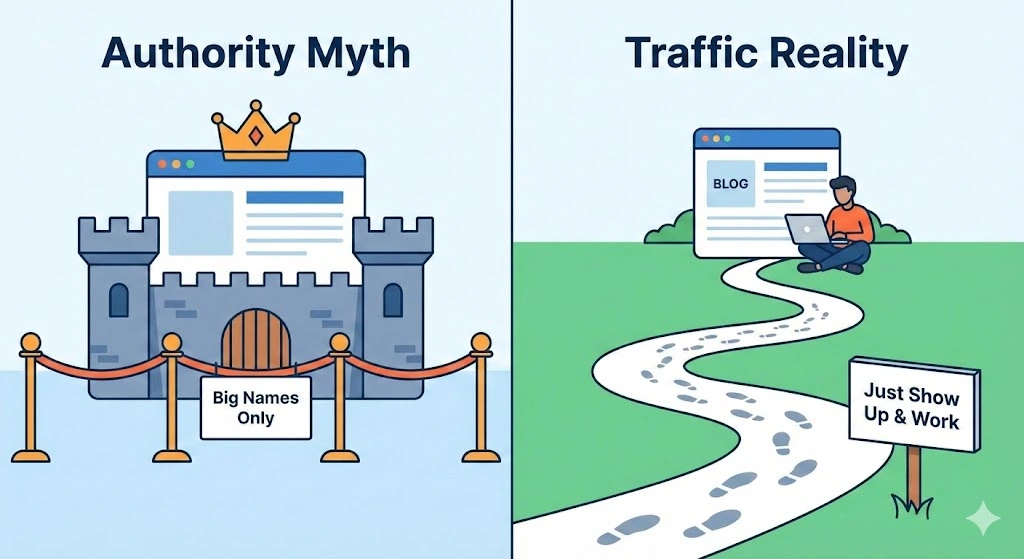
You do not need a big name to win. It is easy to get traffic without authority. You just need to show up and work. People often wait for permission to start. They think titles matter more than effort. But you can get traffic without authority by solving real problems.
Consistency builds trust over time. You prove your worth by showing up daily. This is the reliable way to get traffic without authority. Start today and ignore the doubt. You will get traffic without authority once you hit publish.
1. Why You Can Get Traffic Without Authority Despite “Zero” Volume
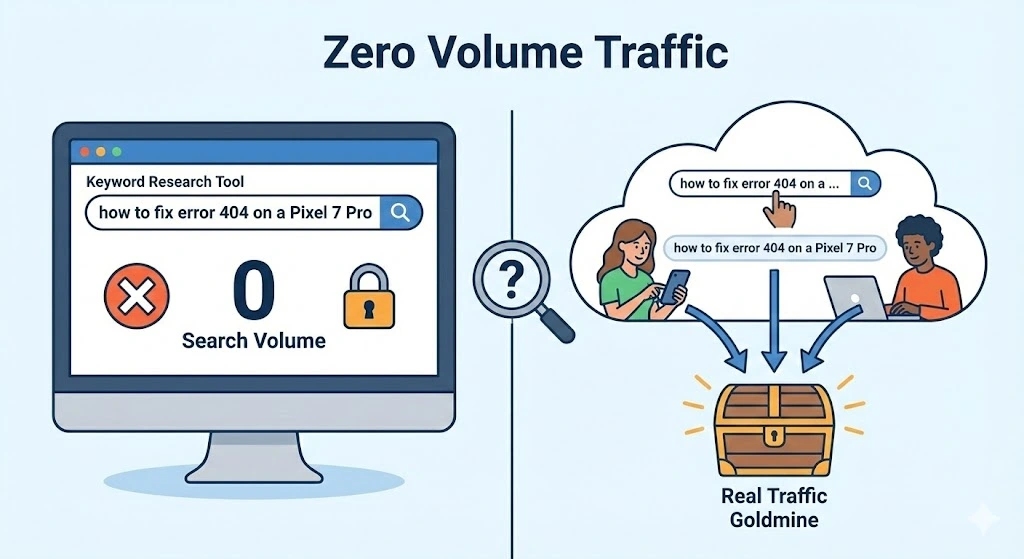
You might wonder why a tool would show “0” if people are actually searching.
The answer is simple: Keyword tools are not Google.
Tools like Ahrefs, Semrush, or Ubersuggest rely on “clickstream data.” They buy data from browser extensions and apps to guess what people are doing. They do not have access to Google’s live database.
If a search phrase is very specific or brand new, these tools often miss it. They do not have enough data points to give you a number, so they just display “0.”
It does not mean “nobody.” It usually means “unknown” or “too new to track.”
I have written articles targeting “zero volume” keywords that bring in 500 visitors a month. The tool was wrong. The traffic was real.
If you trust the tool blindly, you walk away from a goldmine. If you trust your gut and your own research, you can capture that traffic while your competitors sleep.
2. The Benefit: Get Traffic Without Authority and Backlinks
Big websites are lazy. They only want keywords with huge traffic numbers.
If a tool says “10,000 searches,” every big site fights for it. They use strong backlinks to crush small sites like yours.
If a tool says “0 searches,” big sites ignore it. They think it is a waste of time.
This is your advantage
Usually, you need backlinks (links from other sites) to rank on Page 1. Getting backlinks is hard and takes months.
But with Zero Volume keywords, you don’t need them.
Since nobody else wrote about this topic, you have no competition. You are the only runner in the race.
Google has no choice but to rank you at #1 instantly. Authority and power are not required. You just need to show up. That simple step lets you skip the line and get traffic fast.
3. Find Keywords to Get Traffic Without Authority
You cannot rely on standard SEO tools for this. You have to go directly to the source: Google itself.
Here are two simple ways to find these hidden topics.
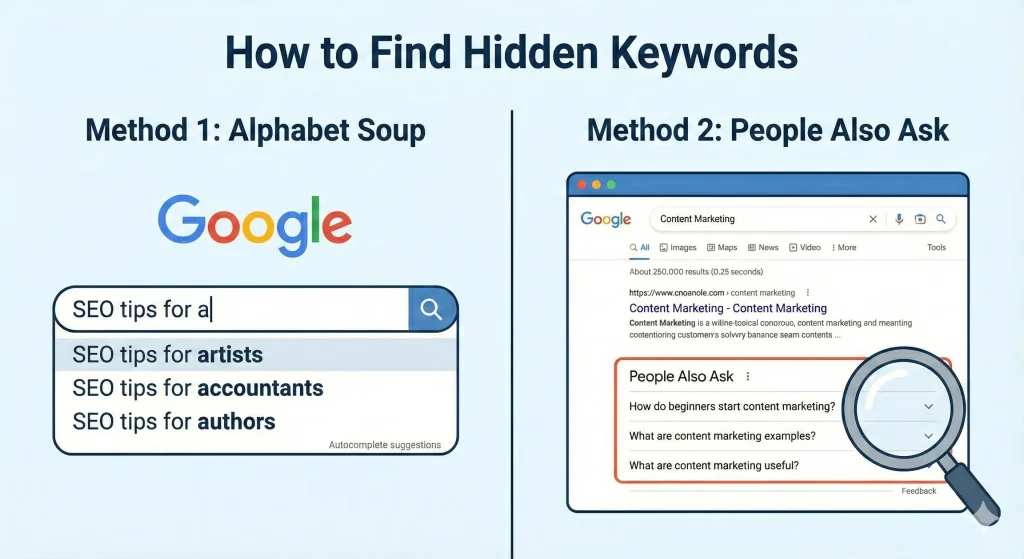
Method 1: The “Alphabet Soup” Technique
Google’s search bar is the best keyword tool in the world. It predicts what people are typing in real-time.
- Go to Google.
- Type your main topic (e.g., “SEO tips”).
- Do not hit Enter. Instead, type the letter “a”.
- Look at the suggestions. Then delete “a” and type “b”.
Example: “SEO tips for a…” might show “SEO tips for artists.” If the tool says “SEO for artists” has zero volume, ignore the tool. Google suggested it because people are typing it right now. Trust Google.
Method 2:
The “People Also Ask” Box Search for a broad topic and look for the “People Also Ask” box in the middle of the page.
These are specific questions real users are asking.
- “Does changing URL affect SEO?”
- “Is 500 words enough for a blog post?”
These are perfect Zero Volume keywords. They are specific questions. If you write a direct answer, you will likely rank #1 for that specific question.
4. How to Write These Articles for Maximum Traffic
When you target these specific questions, you do not need a 3,000-word essay.
You just need to be the most helpful answer in the room.
1. Answer the Question Immediately Do not waste time. If the keyword is a question like “Can I use AdSense on a new site?”, start your article with “Yes, you can.” Then explain how. Google loves direct answers. If you answer clearly, Google might put your text at the very top of the search results (the “Featured Snippet”).
2. Go Deeper Than the Surface Since the topic is specific, you can cover it fully. If you write about “Best SEO tips,” you can never cover everything. But if you write about “How to write a meta description,” you can cover every detail. Show examples. Explain the “Why.” Be the final resource the user ever needs to read on that tiny topic.
3. Link Back to Your Pillars These articles are usually short and specific. Use them to support your bigger articles. Once you answer the question, add a link: “For more details on SEO, read our main guide here.” This pushes authority from your small pages to your big pages. It also stops your pages from competing with each other. For more on that, read Keyword Cannibalization: Why Your Own Pages Are Fighting for Rankings. This keeps your site structure clean.
5. Real Examples of How to Get Traffic Without Authority
It helps to see concrete examples. Here is the difference between a “Head” keyword (High Volume) and a “Zero Volume” keyword.
Example A: The Tech Blog
- High Volume (Hard): “Best Laptops”
- Result: You are fighting Amazon, The Verge, and PCMag. You will lose.
- Zero Volume (Easy): “Best lightweight laptop for nursing students”
- Result: The tool says “0 searches.” But in reality, nursing students are searching for this. If you write it, you are the only expert helping them.
Example B: The Food Blog
- High Volume (Hard): “Chocolate Cake Recipe”
- Result: There are 50 million recipes. Nobody will find yours.
- Zero Volume (Easy): “Dairy-free chocolate cake without avocado”
- Result: This is a specific problem. The person searching for this has an allergy and is desperate for a good recipe. If you give it to them, they will love your site.
The Lesson: High volume keywords are usually people just browsing. Zero volume keywords are people trying to solve a specific problem. They are better visitors.
6. The Trap: Don’t Just Write Randomly
There is one rule you must follow.
Just because a keyword has “Zero Volume” does not mean it is good.
- Bad Zero Volume: “What I thought about while walking my dog.” (Nobody cares).
- Good Zero Volume: “How to fix Error 404 on a Pixel 7 Pro.” (Solves a pain point).
You must focus on User Intent.
Ask yourself: “Does this topic solve a problem?” If the answer is yes, write it. Even if the tool says zero people are looking, someone will eventually have that problem. And when they do, your article will be there to save them.
If the answer is no, skip it. Writing about random, useless topics will get you flagged for “Low Value Content.”
7. Frequently Asked Questions (FAQ)
Q: Will the traffic always stay at zero? A: No. Often, a “Zero Volume” keyword is just a new trend. If you write about it now, you are the first. When the topic becomes popular later, you will already be ranking #1. You are planting seeds for the future.
Q: Can I put AdSense ads on these pages? A: Yes. In fact, these pages often earn more money per click. Advertisers pay more for specific buyers (like “best laptop for nursing”) than for general browsers (like “laptops”).
Q: Do I need any paid tools for this? A: No. You can do this entirely for free. The Google Search bar, “People Also Ask,” and “Related Searches” are the only tools you need.
Q: How many of these articles should I write? A: A good mix is 50/50. Write half your articles on big, main topics to show authority. Write the other half on specific “Zero Volume” questions to catch easy traffic.
Q: Why do my competitors ignore these? A: Because they are chasing big numbers. They want the ego boost of “10,000 views.” They don’t realize that 10,000 views with no clicks is worse than 100 views with high engagement.
Conclusion: Trust Your Instincts, Not the Tool
SEO tools are machines. They only know what happened in the past. They cannot predict the future, and they cannot understand human curiosity.
If you only write what the tools tell you to write, you are just following the herd. You will always be fighting for scraps. But if you trust your own research and answer the specific questions real people are asking, you stand alone. Do not be afraid of the number “0.” In the world of new websites, zero competition is your best friend.
Go to Google today. Type in your main topic. Look at the specific questions people are asking. Write the answer that nobody else has written. That is how you win.